Duncan Baker-Brown, a lecturer and researcher in architecture, won the Green Person award, sponsored by Southern Water, for The Brighton Waste House. The house is built almost entirely of waste materials including thrown-away bricks, ply sheets and wood plus old toothbrushes.
The 20 Argus Achievement Awards, presented by newsreader Nicholas Owen, were handed out at a gala event at Theatre Royal in Brighton.
The inspiration for the Waste House was a house Duncan designed and constructed with Grand Designs presenter Kevin McCloud, called The House That Kevin Built. This sustainable building made almost entirely of compostable materials such as straw, reeds, timber and hemp was built live on Channel 4's Grand Designs Live over six consecutive days, attracting over five million viewers a night.
The Brighton Waste House, which is due to be completed in February, is being built in the grounds of the Faculty of Arts campus at Grand Parade.
Duncan helped to galvanize community groups, business groups, academics, schools and environmental groups to lend their support to the project.
He said: "This is an award for everyone who has worked on the project. The construction industry discards 20 per cent of everything it uses, the equivalent of scrapping one in five houses built. Our aim is to show how low-carbon homes can be built cheaply and quickly using waste including surplus material from building sites.
"This research will inform developments in the construction industry and in the design of houses of the future. Businesses can't afford to keep throwing stuff away and those who start reusing waste will be more likely to survive in the ever-tougher commercial marketplace."
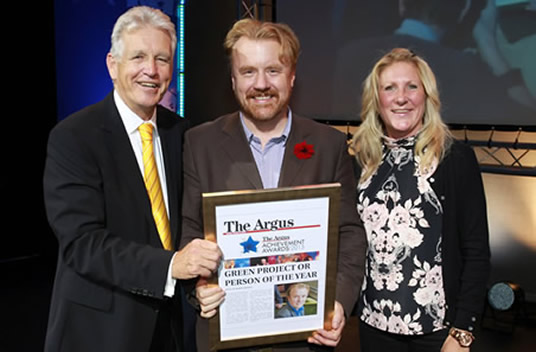
Newsreader Nicholas Owen with Duncan Baker-Brown, and Zoe Smith from Southern Water.
The Waste House has been constructed with the help of over 300 students and volunteers from the Faculty of Arts and City College Brighton and Hove. The scheme is backed by Kevin McCloud and is being supported by Brighton & Hove City Council, a host of companies and internet-based reuse organisation, Freegle. Collaborators include the Mears Group, City College Brighton and Hove, South Downs Solar, Rational Windows & Doors, Velfac, DuPont, Ejot among others.
The house, which will be one of the first A* energy-efficient rated buildings in the UK, will showcase new technologies and will be used as an exhibition and workshop space by local community groups and as the University of Brighton's headquarters for sustainable design.
Michael Beard, editor of The Argus said: "The Argus Achievement Awards are quite simply one of the best things that The Argus is involved in.
"It's so important to celebrate and recognise everything that's good in our community and give back to those people who selflessly give up many hours of their time without much, if any, recognition.
"The fact that we had a record number of nominations this year shows that it's growing in popularity which we're absolutely delighted about.”