The university and Sussex-based Ricardo UK, world leaders in engineering technology consultancy, have been collaborating since the 1990s and today's announcement will move the project forward to the design and rig testing of critical components stage.
Most car manufacturers produce electric or low-emission hybrid vehicles but heavy-duty trucks and similar vehicles are proving more difficult to convert. Ricardo and the university are being funded in part by the Technology Strategy Board – the UK's national innovation agency which aims to accelerate economic growth by stimulating and supporting business-led innovation.
Ricardo's new CryoPower engine concept focuses on a split-cycle combustion process instead of refining existing four-stroke engine technology. The engine divides these four strokes between two paired cylinders: one for intake/compression, and another for power/exhaust. The concept is based on a split cycle, temperature controlled system, which increases engine efficiency.
The new research announced today will bring in heat exchanger specialists HiFlux and an advisory panel drawn from the heavy duty engines and vehicle sector, with the ultimate aim of bringing the engine to market.
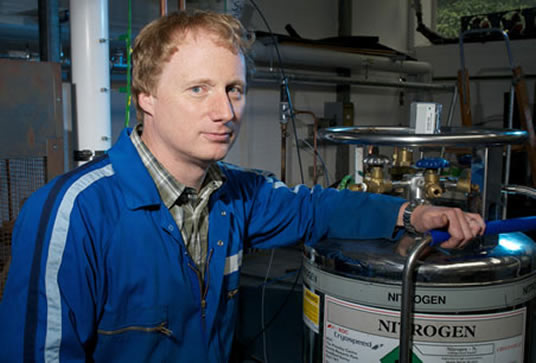
Dr Robert Morgan
In the 1990s while working at Ricardo, Dr Robert Morgan, principal research fellow in the University of Brighton's School of Computing, Engineering and Mathematics, led the Ricardo split-cycle engine research project investigating a power generation application. Dr Morgan subsequently worked with Dr David Mason on the project in collaboration with Ricardo in 2012. He said: "This is an exciting project that should enable us to start realising the potential demonstrated in feasibility studies that we conducted in collaboration with Ricardo."
Professor Neville Jackson, Ricardo's chief technology and innovation officer, said: "The need for fundamentally-new powertrain solutions to reduce the carbon footprint of heavy duty road transportation is widely accepted, not least because the electrification approaches currently being demonstrated for passenger cars are inappropriate for this scale of vehicle.
"By fundamentally readdressing the underlying thermodynamics of the internal combustion engine we believe the Ricardo split-cycle cryogenic injection combustion concept offers the prospect of very significant improvements in thermal efficiency and hence reduced carbon dioxide emissions."